
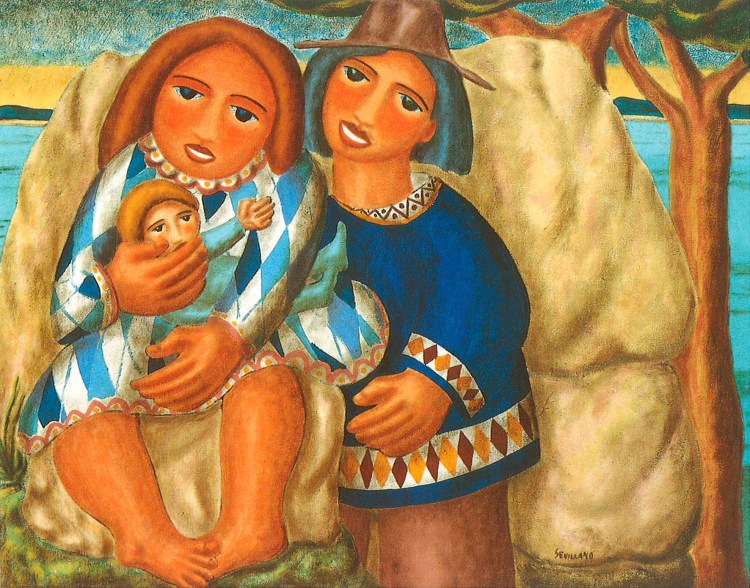
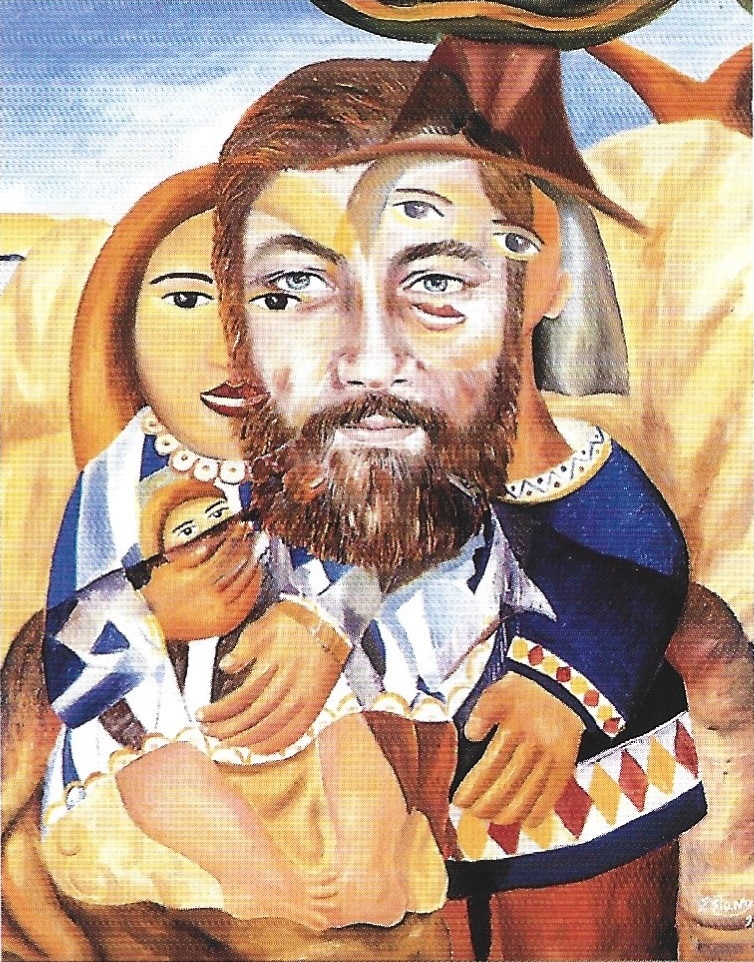
The Family
Ángel Sevillano Estremera (1942 – 1994), Spain 1992
Oil on canvas
Credits: Sevillano Collection. Galician, Spain
Sevillano painted this oil in 1992, upon returning to Spain, in an allegory of the international family he formed with Spanish and American roots. In the background landscape appear the unmistakable Rías de Galicia with the silhouettes of the mountains and their vegetation, and a sunset in golden tones over which nightfall can already be seen. The representation of the father, as a Wayuu Indian, indigo blue hair, wearing a hat and clothes with the typical geometric designs; the Spanish mother, with a child on her lap and dressed in rhombuses in light blue tones, plays with the remaining variety of blues in the painting. We can appreciate the technique of shading and lighting that Sevillano developed, and that defines very well the characteristic faces of his characters.
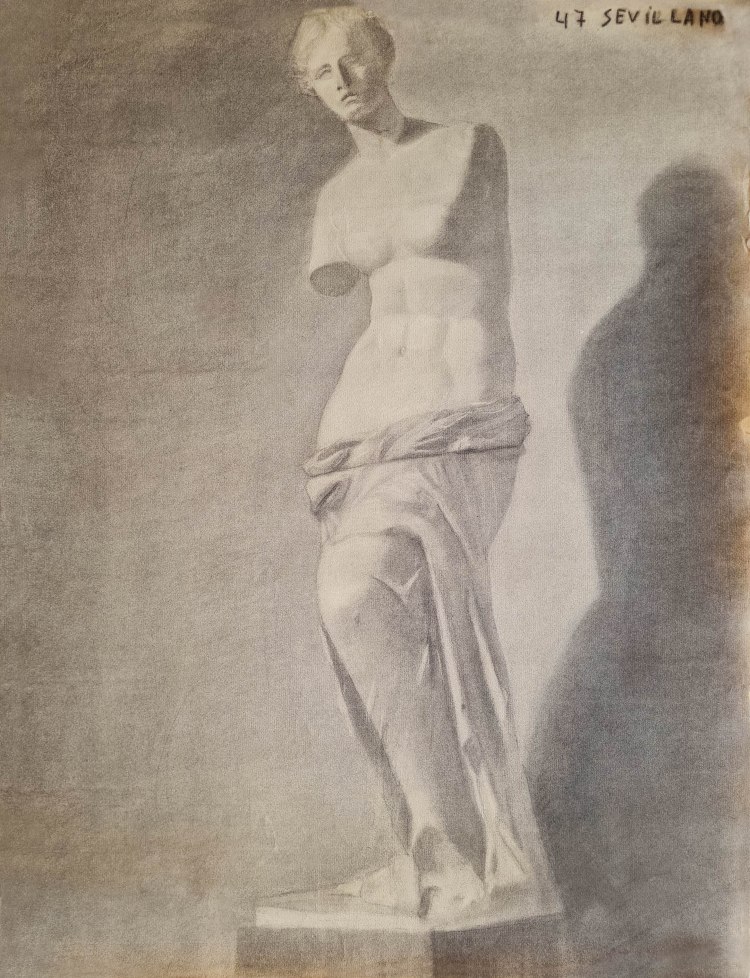
Venus de Milo
Ángel Sevillano Estremera (1942 – 1994), Spain 1963
Charcoal on paper
Credits: Sevillano Collection. Galician, Spain
One of Sevillano’s works in the Faculty of Fine Arts with which students were evaluated in drawing. It belongs to a small series of sculptures that he drew; here we can see La Aphrodite de Milo, better known as Venus de Milo, one of the most famous sculptures of ancient Greece that is in the Louvre Museum in Paris, France.
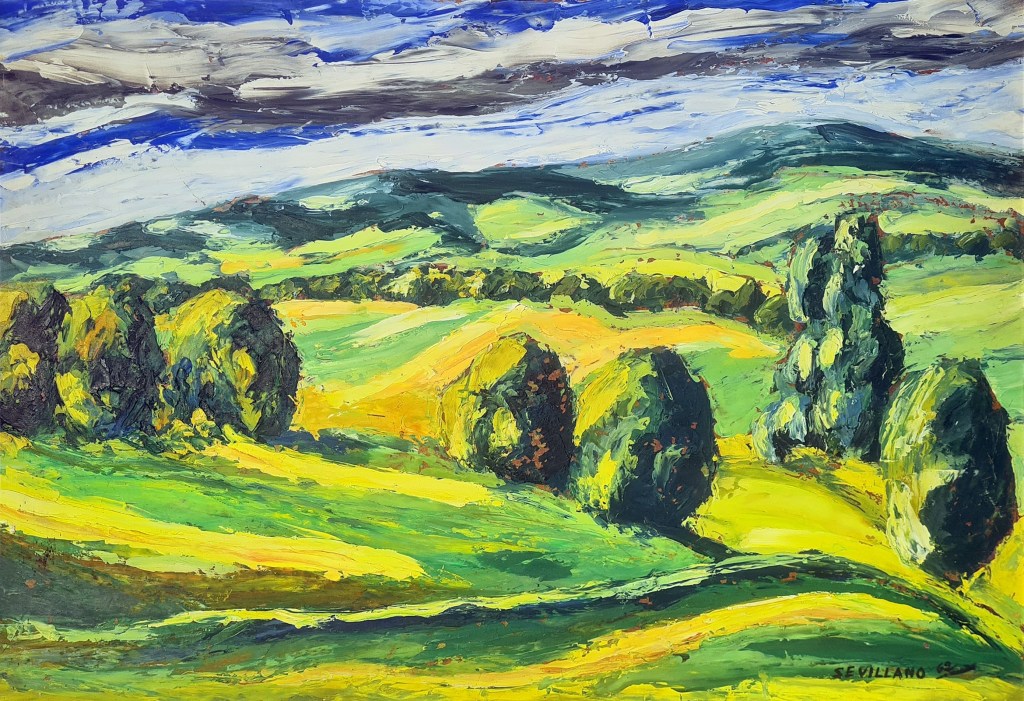
Summer Landscape
Ángel Sevillano Estremera (1942 – 1994), Spain 1962
Oil on wood
Credits: Sevillano Collection. Galicia, Spain 1962
Painted in 1962, at the beginning of his career when the themes of his paintings were about landscapes. Sevillano used in this painting a strong contrast of blue, green and yellow that well reflect the tones of the fields of Galicia during the summer. On the horizon you can see the silhouette of the mountains, and how the clouds mix a little with the morning fog that appears in the fields. The brush strokes that make up the curves seem to dance and move within the landscape, creating the perception of movement.
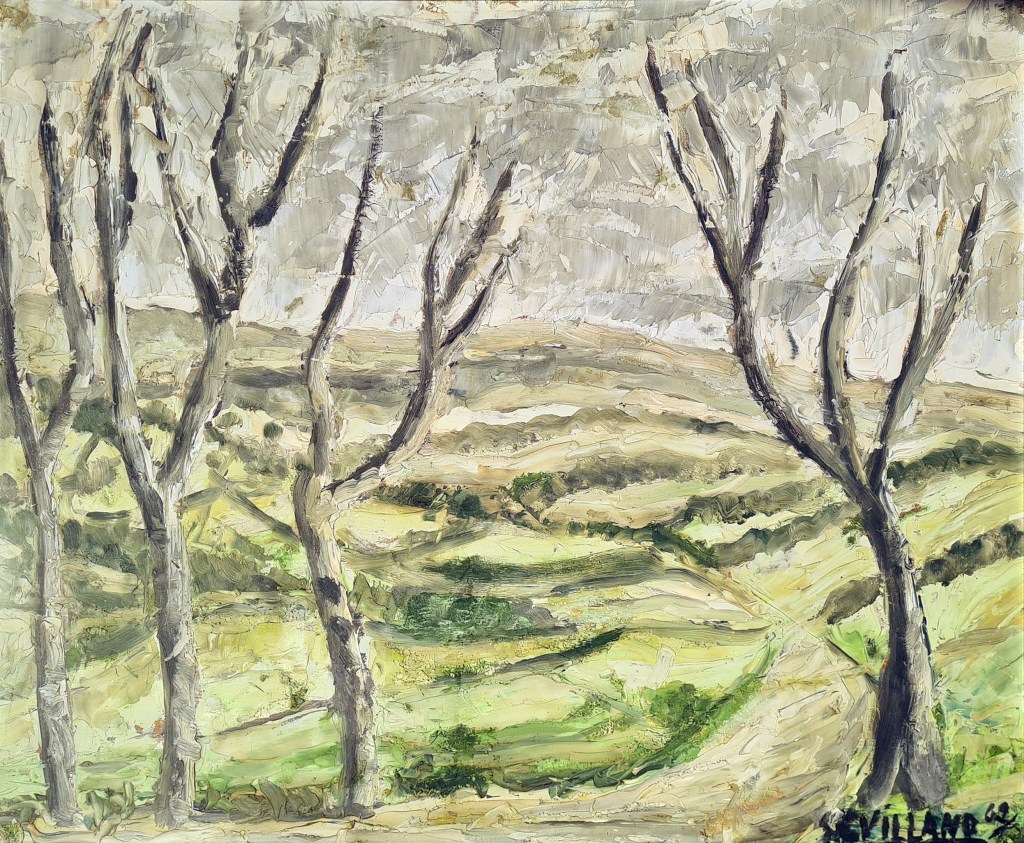
Winter Landscape
Ángel Sevillano Estremera (1942 – 1994), Spain 1962
Oil on wood
Credits: Sevillano Collection. Galician, Spain
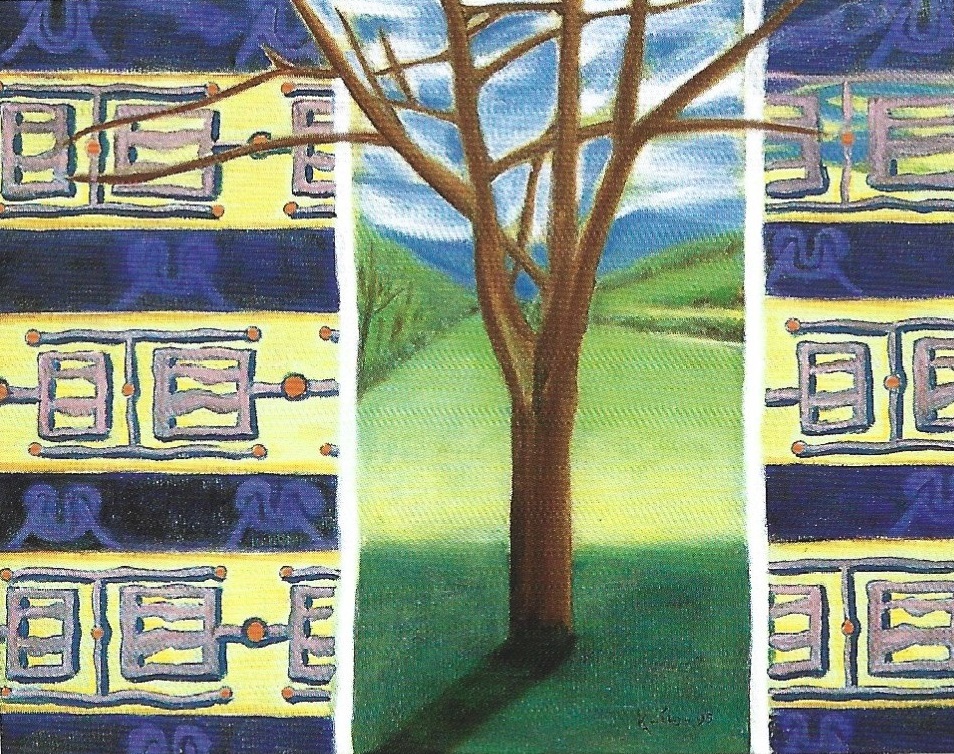
Contrary to Summer Landscape, Sevillano wanted to capture in this painting the sensation of a winter day: the cold colors, the trees bare of leaves, the cloudy sky, a landscape that gives the impression of being frozen, sleepy, waiting for the arrival of the spring to revive.
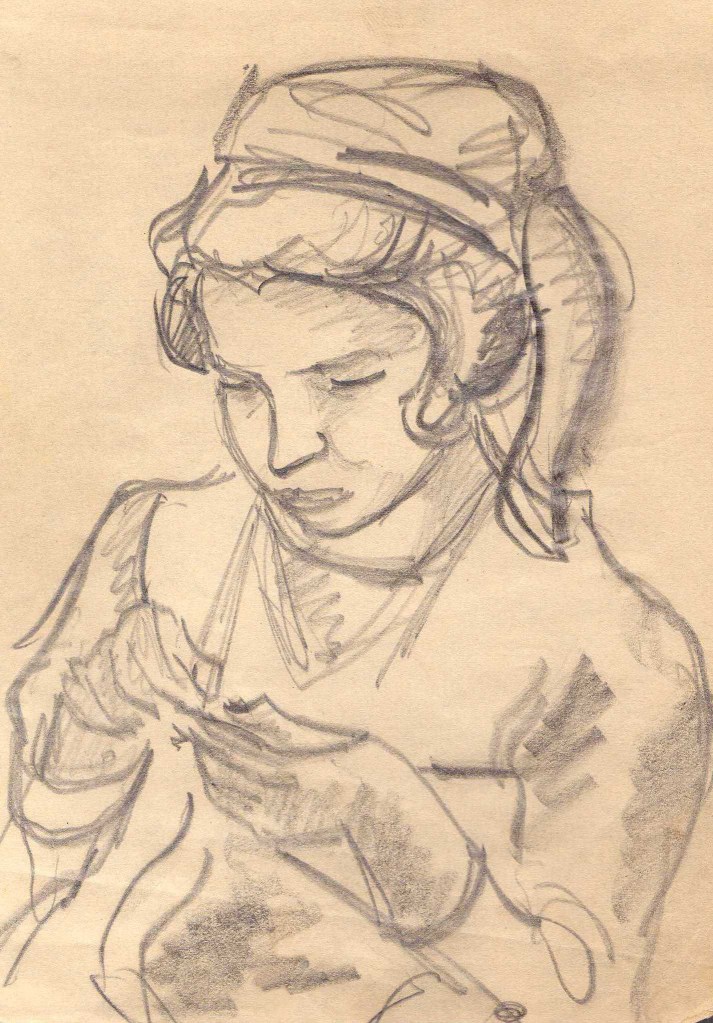
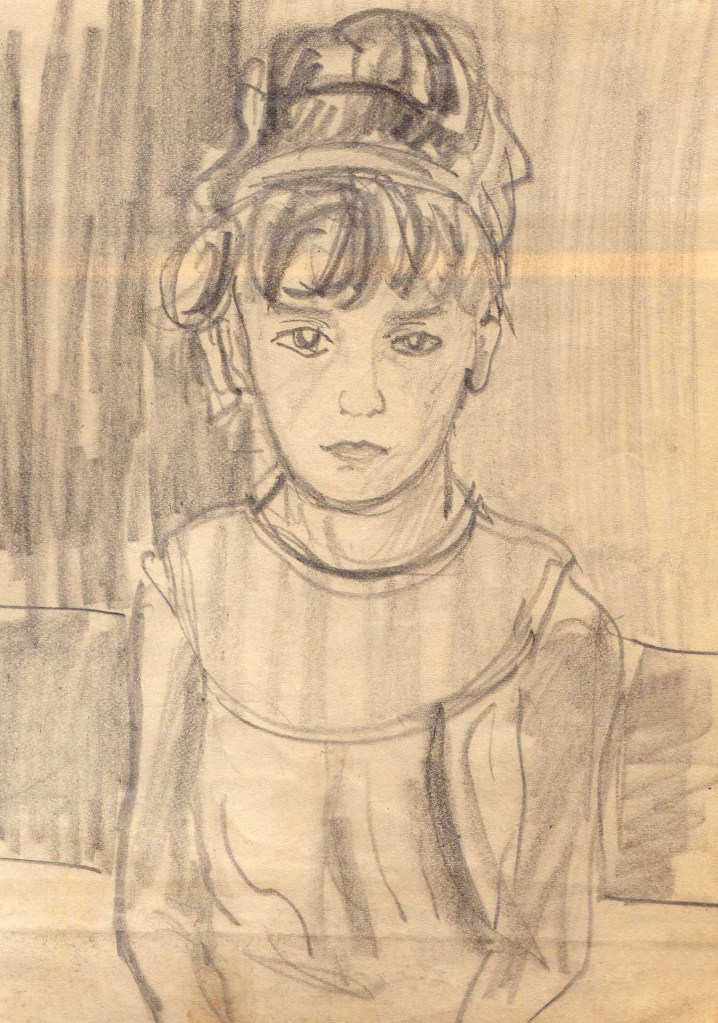
Sketches
Ángel Sevillano Estremera (1942 – 1994), Spain 1963
Pencil on paper
Credits: Sevillano Collection. Galician, Spain
Sketches of a girl and a woman sewing that illustrate the journey that the human figure took in Sevillano’s work, before developing the personal style that characterizes his paintings.
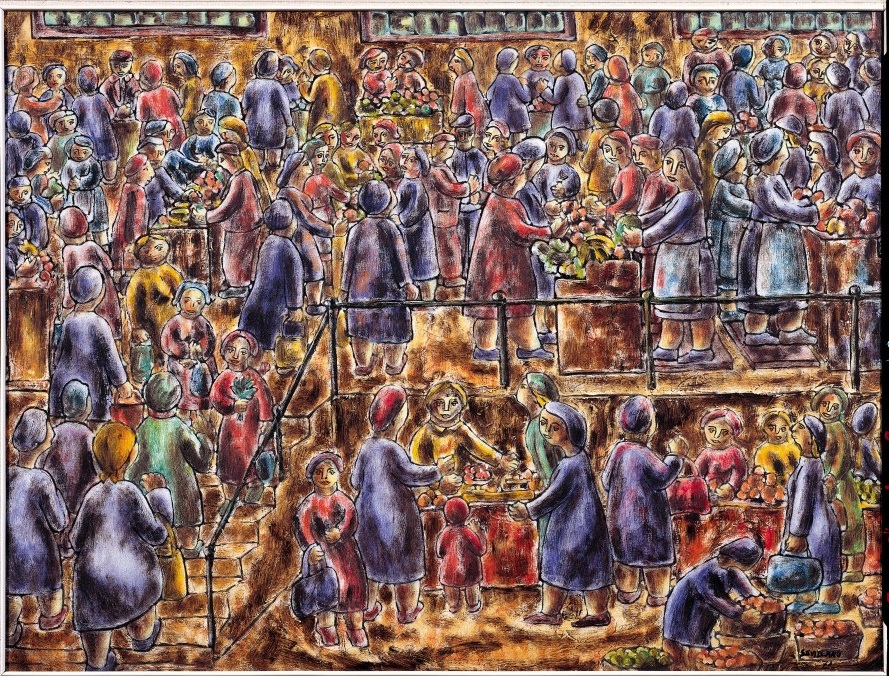
The Market
Ángel Sevillano Estremera (1942 – 1994), Spain 1971
Oil on wood
Credits: Afundación, Abanca Social Work Collection
Traditional open-air markets around the world are famous. Sevillano captures in this scene a variety of characters, each of them unique, busy going back and forth shopping for fruit and vegetables. This work belongs to the stage where the human figure appeared in the work of Sevillano, generally portrayed in crowds that participate in some event or daily chore, as shown in this painting.
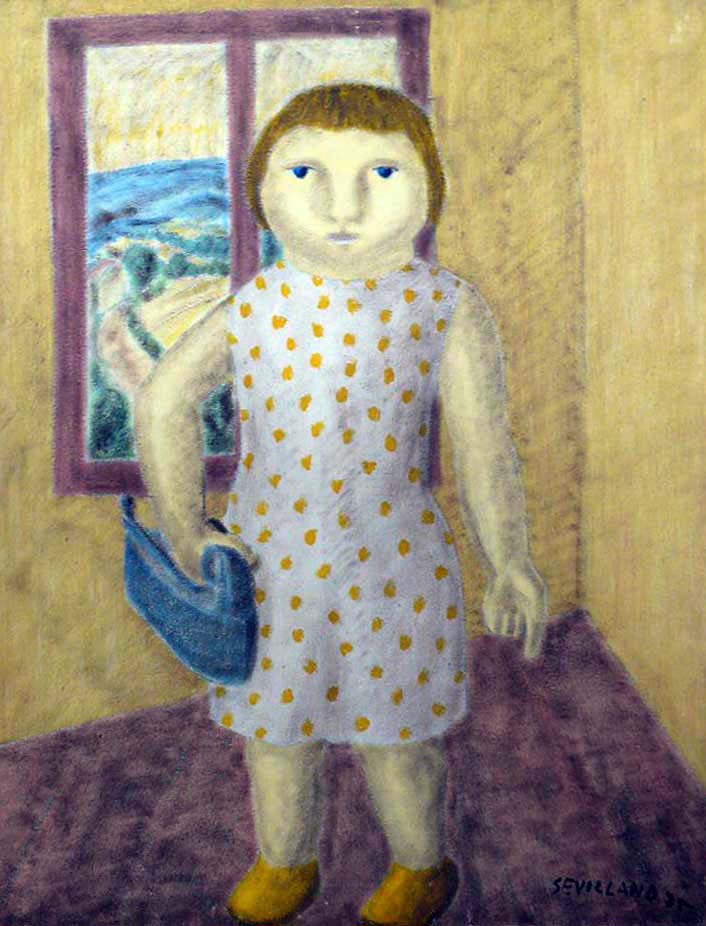
Young man with iron
Ángel Sevillano Estremera (1942 – 1994), Spain 1975
Oil on canvas
Credits: Sevillano Collection. Galician, Spain
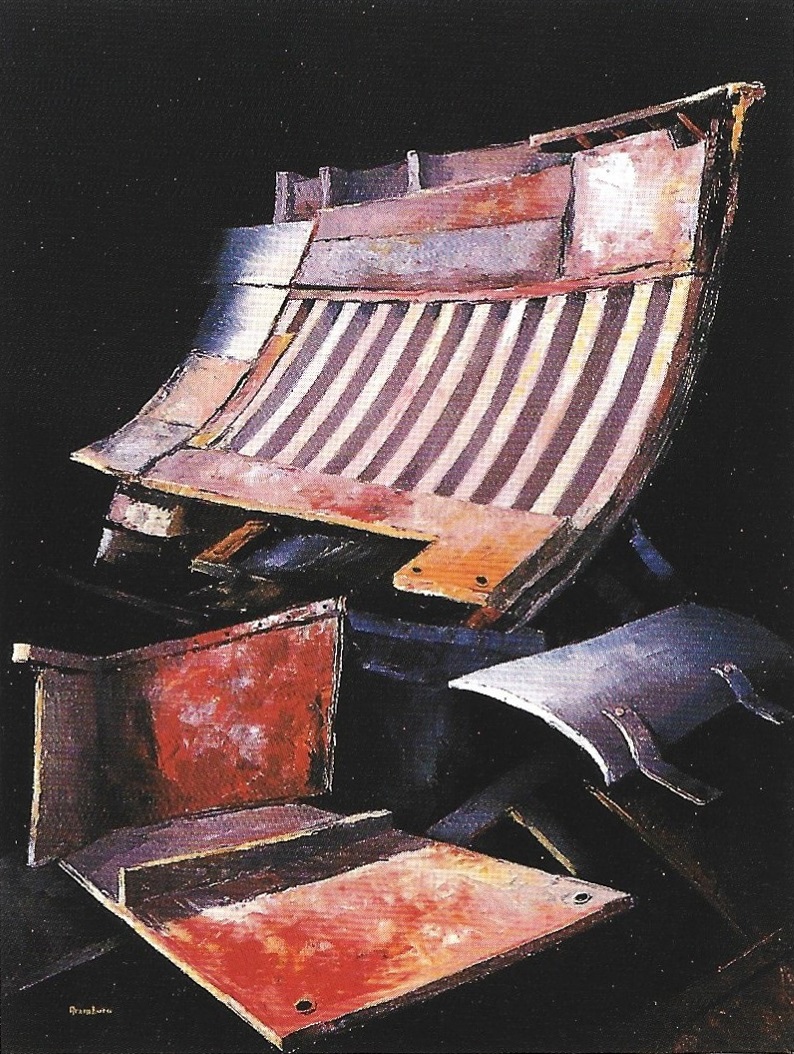
There are a series of paintings on canvas from the first stage, which portray still lifes and characters to which this painting belongs. Here a young woman is about to do some work, so she carries an old iron plate in her right hand. The dotted dress and shoes contrast with the soft pastel yellow of the room. In the background in the window, we can see a valley at dawn. Sevillano who liked to collect some objects, he had several old iron plates among his possessions.
The Yellow Kitchen
Ángel Sevillano Estremera (1942 – 1994), Spain 1975
Oil on canvas
Credits: Sevillano Collection. Galician, Spain
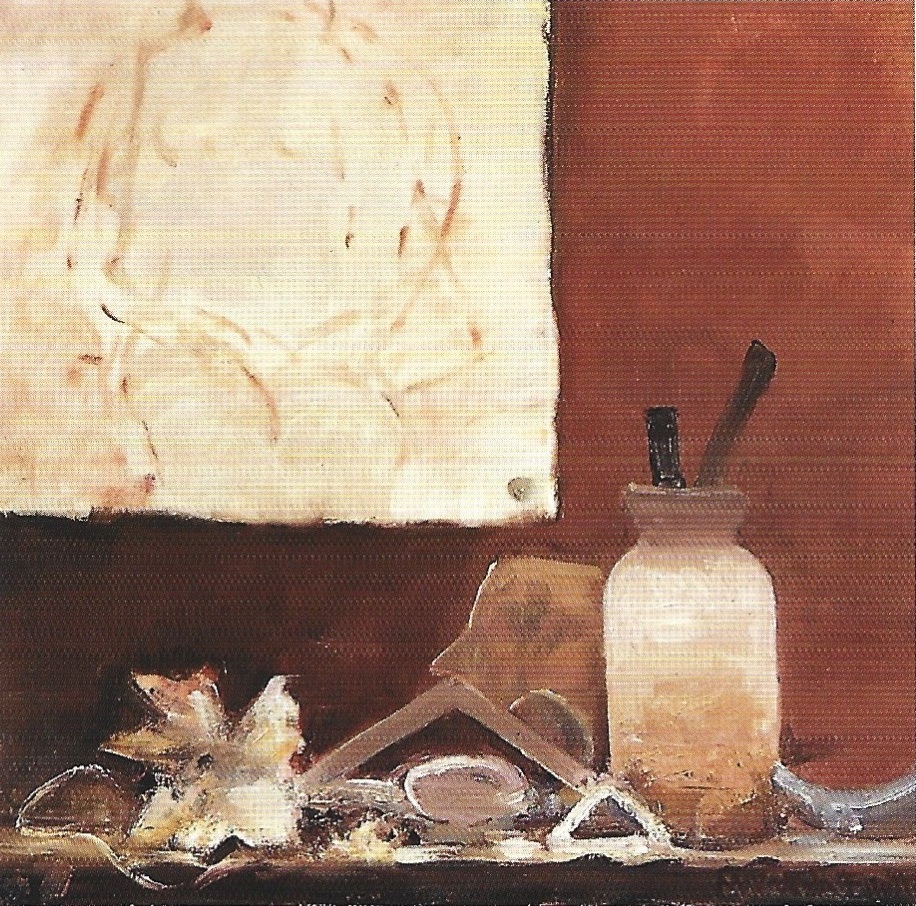
From the series of still lifes, The Yellow Kitchen portrays many of the objects which were in daily use at the beginning of the 20th century, not only in Galicia but in many towns and cities in Europe. Copper cookware, a stone sink with a manual water pump, and a wooden dish drainer hanging on the wall; They tell us about a time that has little to do with the comforts of modern life. But that takes us back to the charm and calm that life had in the past.

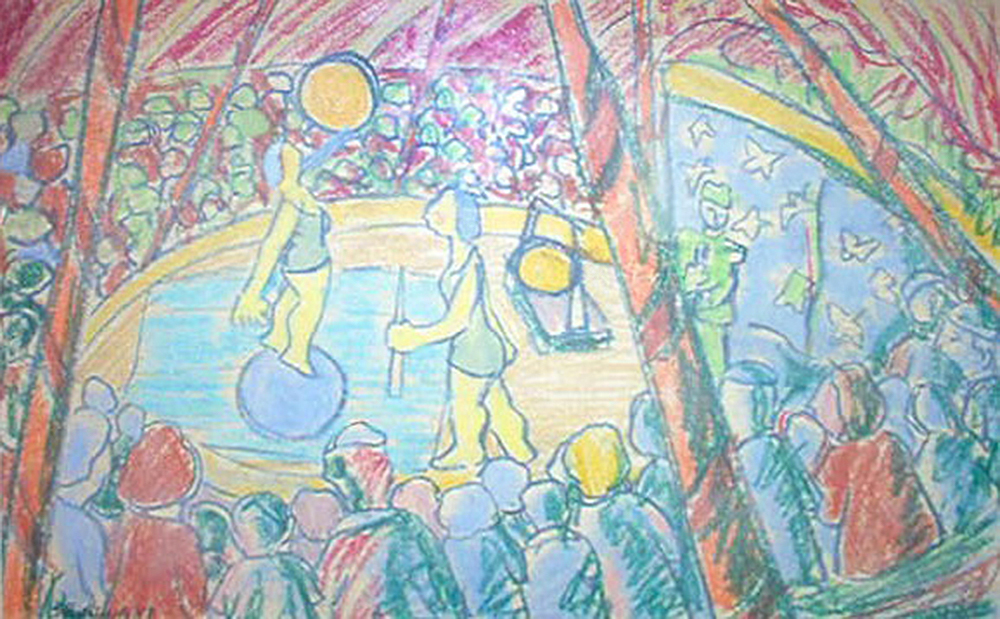
The Circus Show
Ángel Sevillano Estremera (1942 – 1994), Spain 1979
Pastel on paper
Credits: Sevillano Collection. Galician, Spain
Sevillano created several works on circus themes. In The Circus Show, jugglers appear in the center of a stage performing acrobatics before the attentive gaze of the public, while in the background a magician appears to be doing tricks with pigeons flying in all directions. A very common scene in Spain in the mid-20th century, where circus performances were presented at fairs and towns for the entertainment of children and adults. The work is done in pastel, another of the techniques that Sevillano used recurrently in his art.
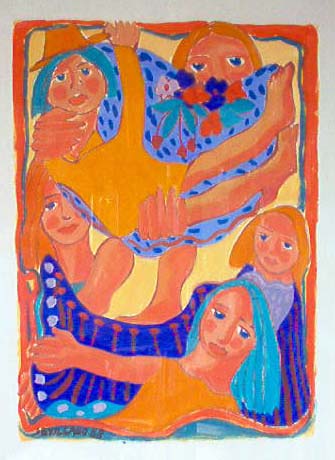
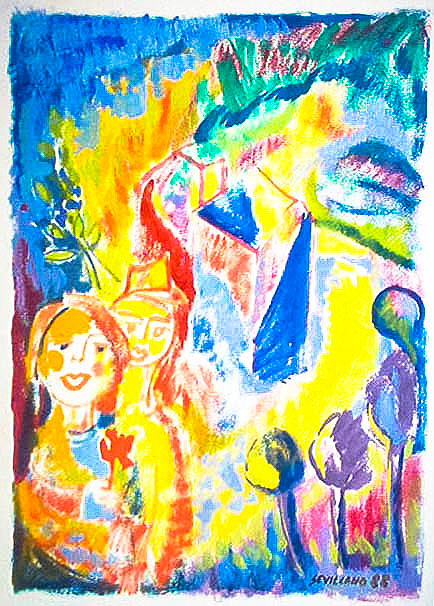
Levitating Characters and Dreaming in Abstract Colors
Ángel Sevillano Estremera (1942 – 1994), Spain 1988
Pastel on paper
Credits: Sevillano Collection. Galician, Spain
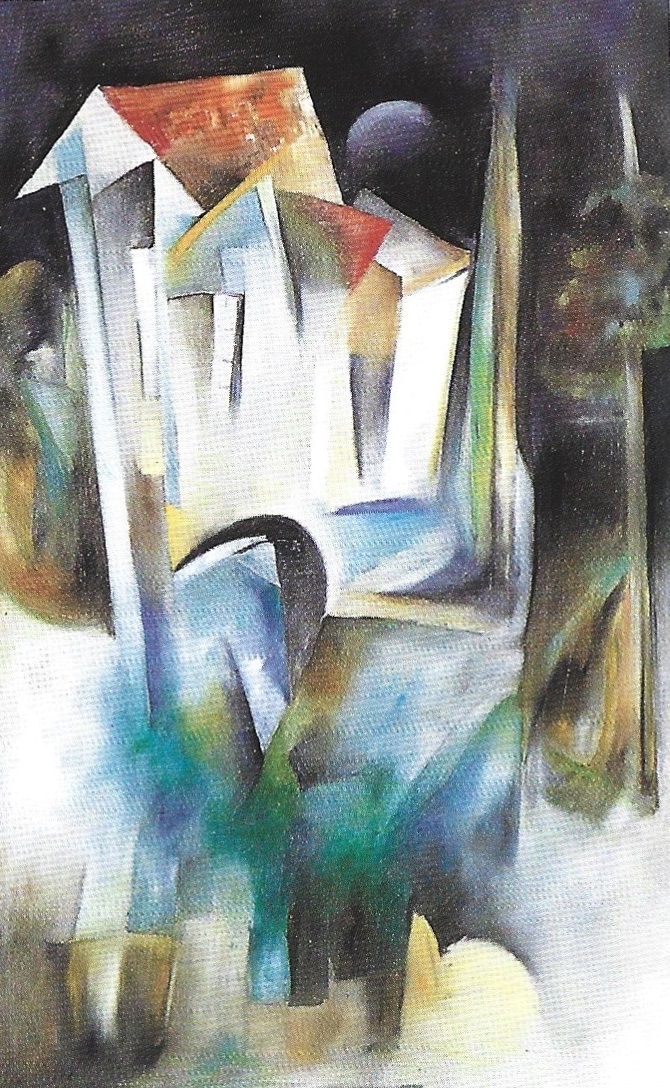
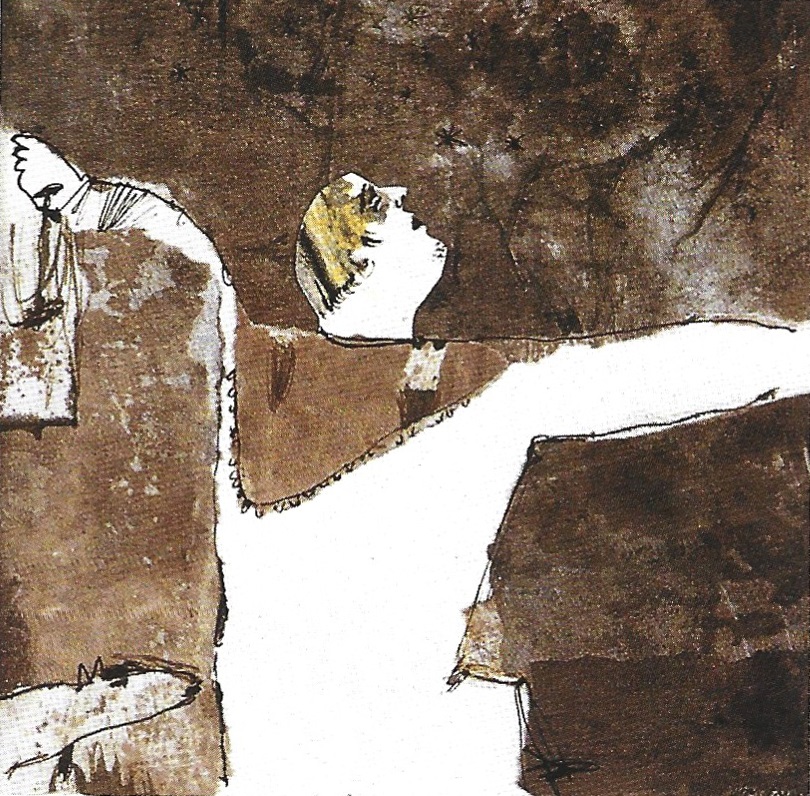
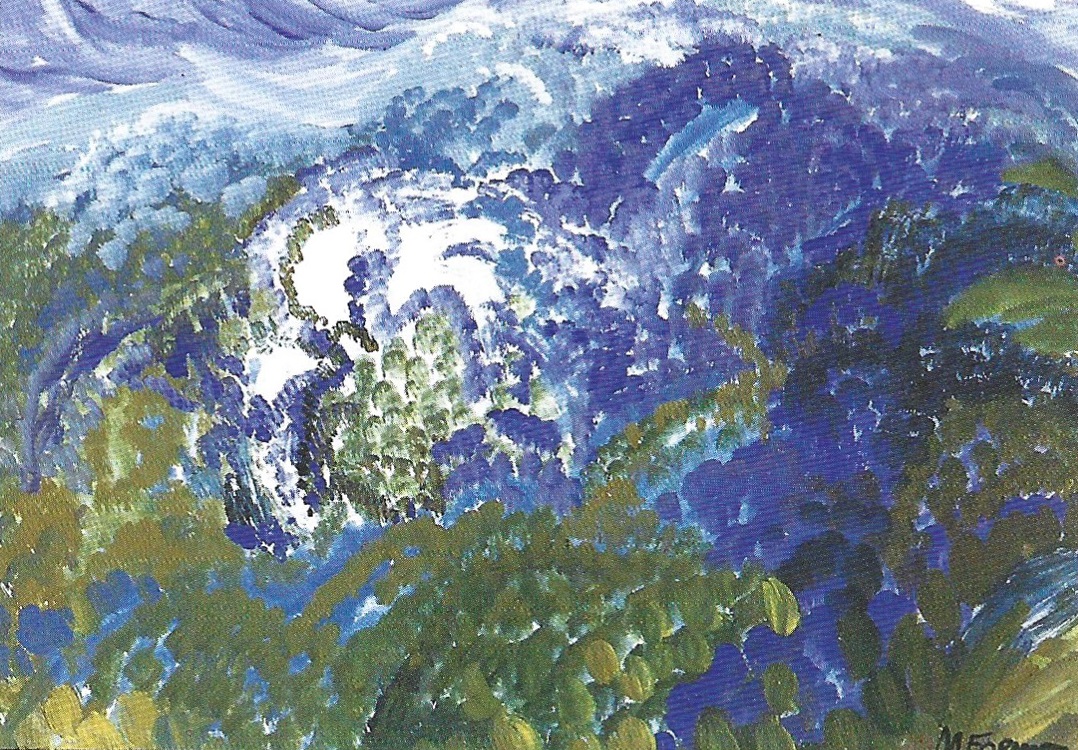
Upon returning from America, Sevillano’s work had been filled with color and some surrealism. His characters now levitate, wear hats, colored hair, and suits with Amerindian geometric patterns. There was a small series of paintings made in pastel on paper in 1988, in very vivid colors and a surreal air, these two paintings belong to them: Levitating Characters, where they seem to celebrate and lift up an American figure wearing a hat. And Dreaming in Abstract Colors, where a couple appears worked with brushstrokes, and in the background a street with houses that rises until it fades in the middle of a whirlwind of colors.
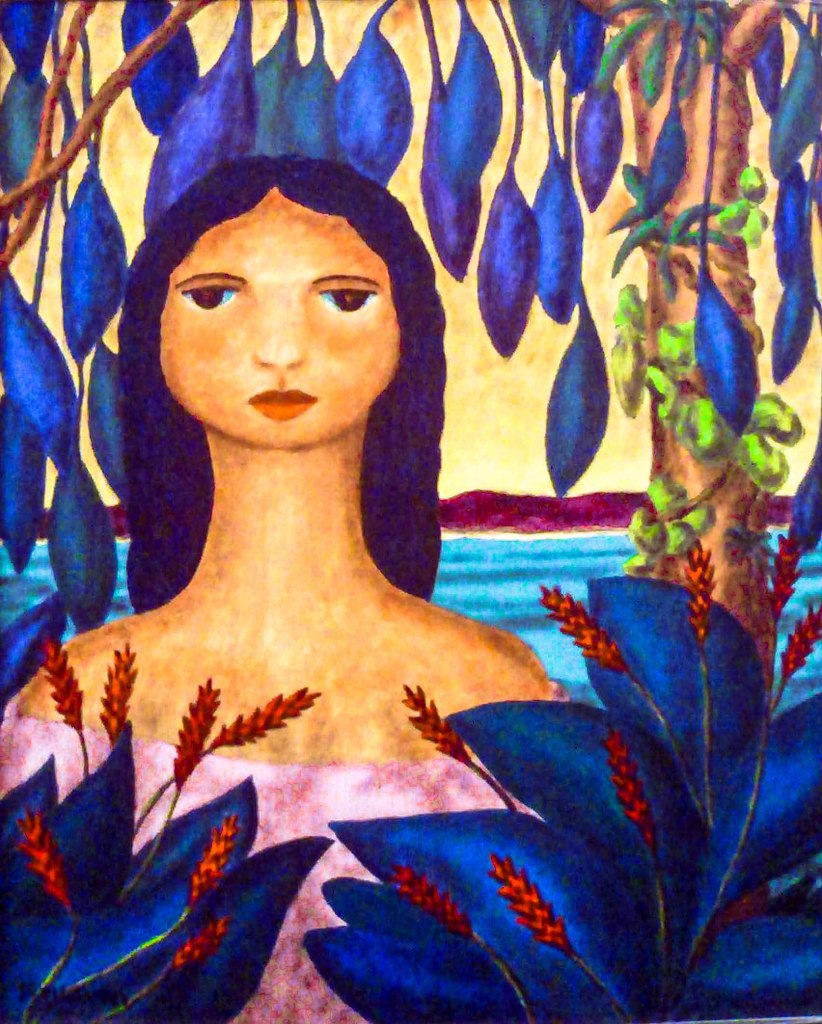
Tropical Girl
Ángel Sevillano Estremera (1942 – 1994), Spain 1987
Oil on wood
Credits: Sevillano Collection. Galician, Spain
A young woman with long jet-black hair poses behind lush Heliconia flowers, and in the background a beach with turquoise waters can be seen through the hanging leaves of the trees.
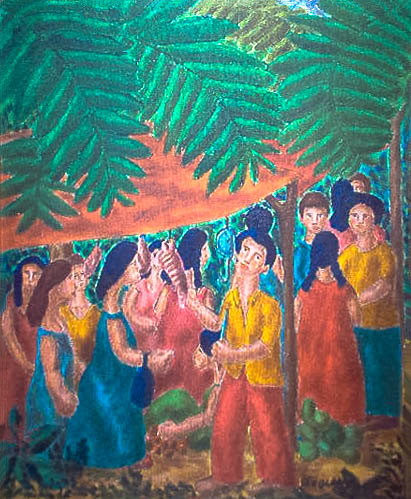
Caribbean Market
Ángel Sevillano Estremera (1942 – 1994), Spain 1987
Oil on wood
Credits: Sevillano Collection. Galician, Spain
Another market portrayed, but this time in America. This unique work painted by Sevillano, portrays well the hustle and bustle of the vendors’ stalls in the Caribbean markets, where they offer everything from fruits to handicrafts. A skilled shopkeeper offers yucca to a buyer who appears to negotiate the price, while a woman who sells coconuts and medlars sits on the ground to rest waiting for customers to arrive. At the same time as another group of people chatting animatedly in a corner. All under the shade of awnings and palm trees that cover them from the hot Caribbean sun.
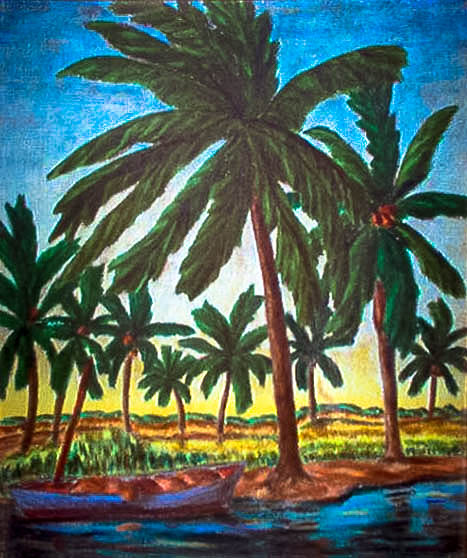
Palm trees at sunset
Ángel Sevillano Estremera (1942 – 1994), Venezuela 1985
Oil on wood
Credits: Sevillano Collection. Galician, Spain
The landscapes, colors and crafts of America had a notable influence on the new artistic production of Sevillano. Palm Trees at Sunset, portrays a native landscape of the Caribbean coast: a beach with a multitude of coconut trees, where a fisherman’s boat is moored. On the horizon you can see the silhouette of a dense vegetation of trees, while night falls.
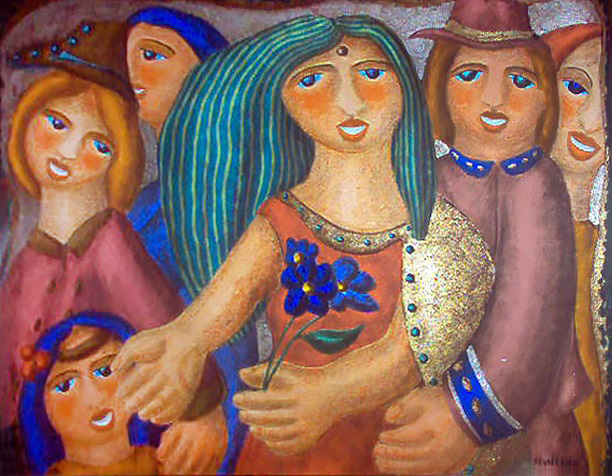
The Goddess of the Third Eye
Ángel Sevillano Estremera (1942 – 1994), Spain 1992
Oil on canvas and 24-carat gold leaf
Credits: Sevillano Collection. Galician, Spain
A goddess with green and gold hair carries a gold shield on her shoulder and flowers in her hand, while she is surrounded by a retinue of characters. On his forehead you can see a mark that symbolizes the agna-chakra, better known as the third eye. This work is a reflection of Sevillano’s intellectual curiosity towards metaphysical themes typical of Eastern religions, such as reincarnation or karma. The work is done in oil on canvas, with the application of the gold leaf technique.
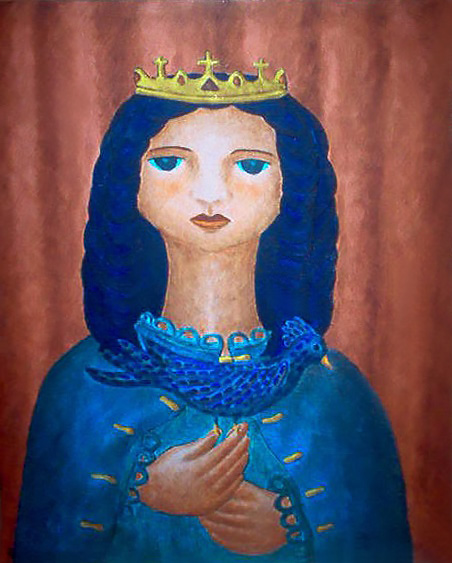
Virgin of the Blue Bird
Ángel Sevillano Estremera (1942 – 1994), Venezuela 1986
Oil on wood
Credits: Sevillano Collection. Galician, Spain
During his career Sevillano painted several religious images, among which are some virgins. The Virgin of the Blue Bird is a beautiful representation of Mary where we see her adorned with a golden tiara, tunic and cape in shades of blue, carrying in her hands a bird with blue plumage. Her complexion is brown and her long hair and dark eyes; reflection that the work was done during the time she lived in Venezuela.
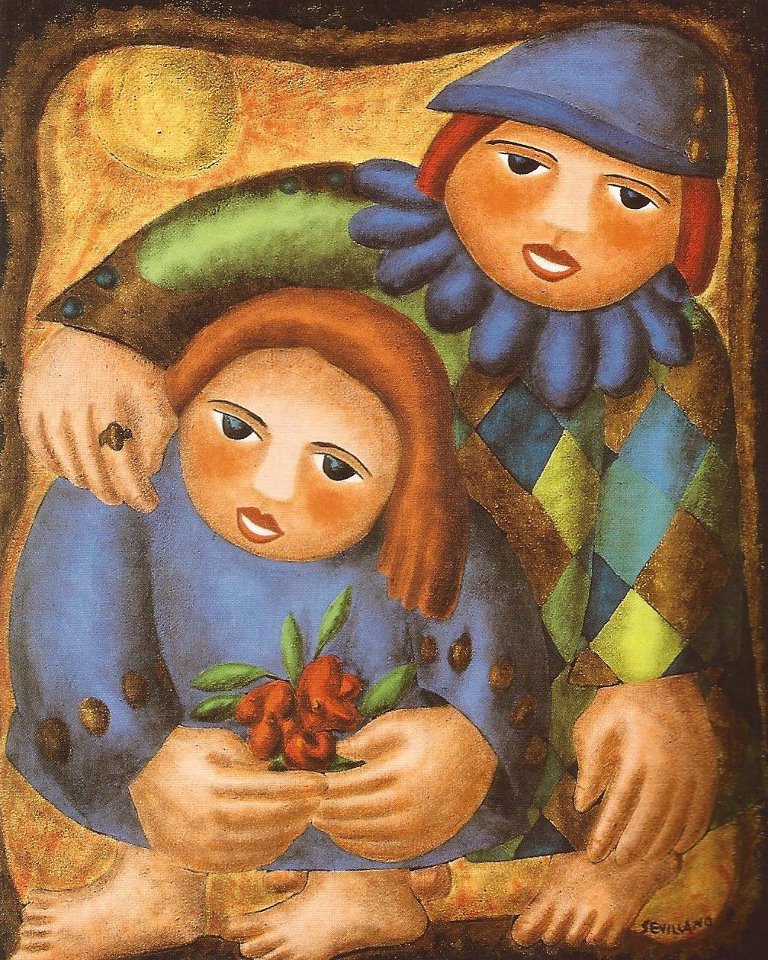
The Harlequin and the Lady
Ángel Sevillano Estremera (1942 – 1994), Spain 1992
Oil on canvas and 24-carat gold leaf
Credits: Sevillano Collection. Galician, Spain
A character dressed as a harlequin affectionately embraces a lady who appears to be courting her. She carries a small bouquet of red flowers in her hand, while in the left corner shines a brilliant sun that radiates its rays in all directions. The somewhat surreal scene is framed in a golden border, through which the couple of characters stand out, seeming to look happy and attentive at the viewer.
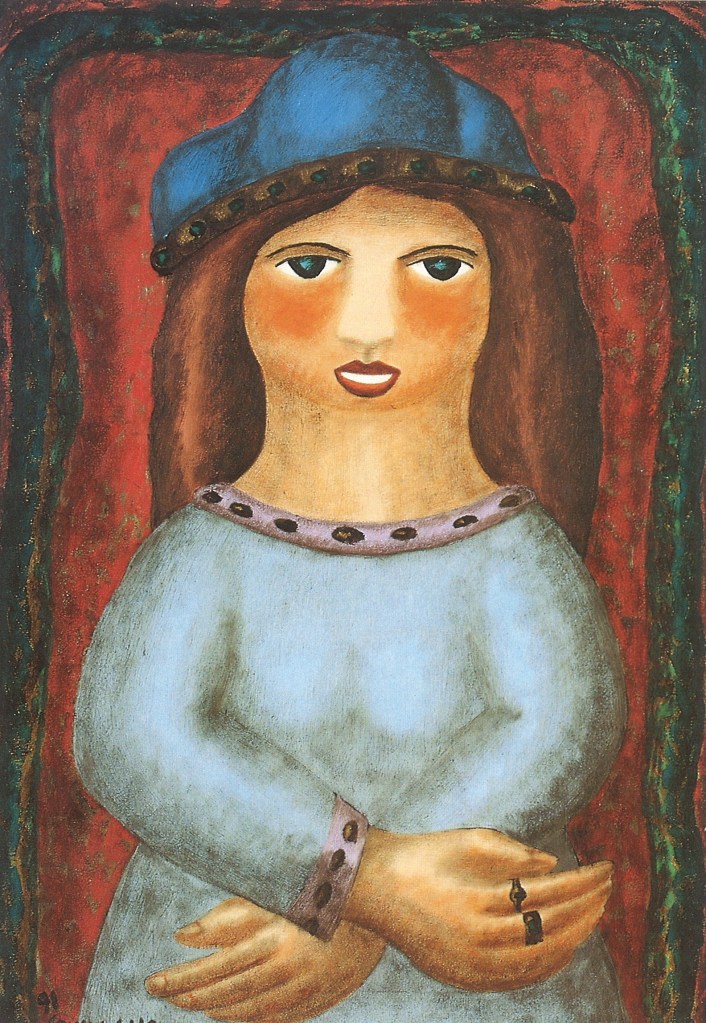
Jeweled Lady
Ángel Sevillano Estremera (1942 – 1994), Spain 1992
Oil on wood and 24-carat gold leaf
Credits: Sevillano Collection. Galician, Spain
A richly dressed lady poses smiling with her hands crossed, in front of a crimson background; Her hat stands out, reminiscent of medieval fashions, and the rings on her right hand. The work has gold leaf applications in the small veins of the background and the details of the clothing and jewelry.

Boarding the Plane
Ángel Sevillano Estremera (1942 – 1994), Spain 1992
Oil on canvas
Credits: Private Collection
Last known sale in Galicia, Spain
A group of passengers is about to board a plane, waiting anxiously with their luggage on the tarmac of an airport; in the background silhouettes of mountains can be seen on the horizon. Sevillano painted several paintings with scenes of migrations by boat (in allegory to the migrations of the 20th century to America), but this work is the only one where an aircraft can be seen.
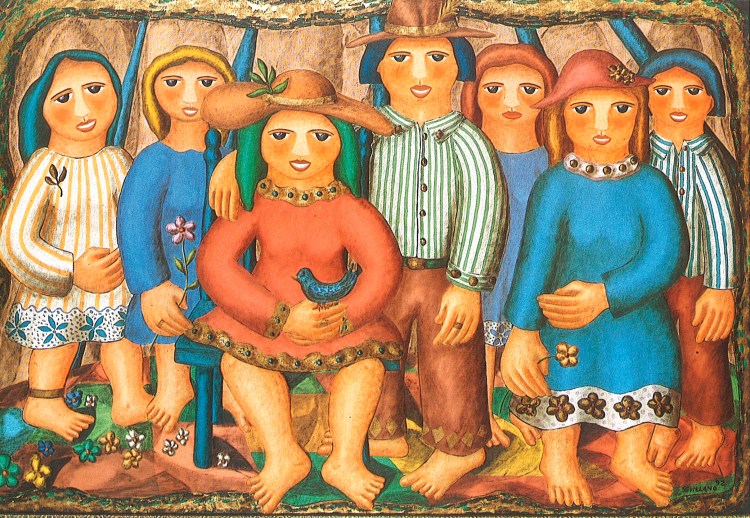
Spanishness
Ángel Sevillano Estremera (1942 – 1994), Spain 1992
Oil on canvas and 24-carat gold leaf
Credits: Art Collection of the Government of the Community of Galicia. Government of Galicia, Spain
A group of characters pose smiling in front of an abstract background. In the center a couple: she sitting with a blue bird in her hand, and he with a Wayuu-style hat, surrounded by others who carry flowers in their hands, in what seems to be a symbol of friendship. This work made for the Government of Galicia, was worked with the new techniques that Sevillano began to apply shortly before his death. We can see the application of gold leaf around the painting, and in details of the clothing and jewelry of the characters.
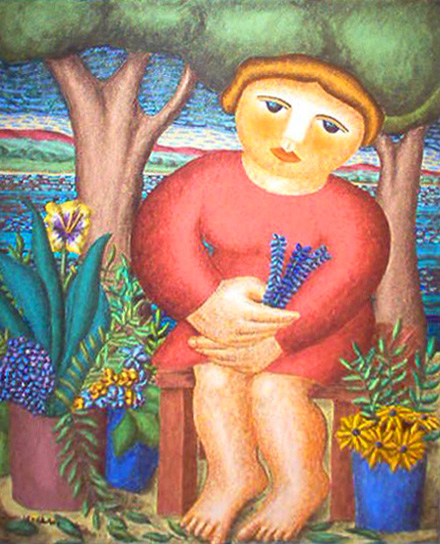
The Secret Garden
Ángel Sevillano Estremera (1942 – 1994), Spain 1992
Oil on canvas
Credits: Sevillano Collection. Galician, Spain
A barefoot young woman sits peacefully in a garden surrounded by flowers and trees. In her hand she holds a sprig of lavender, while in the background you can see a lake with sparkling turquoise waters bordered by mountains. A work that transmits a lot of serenity.
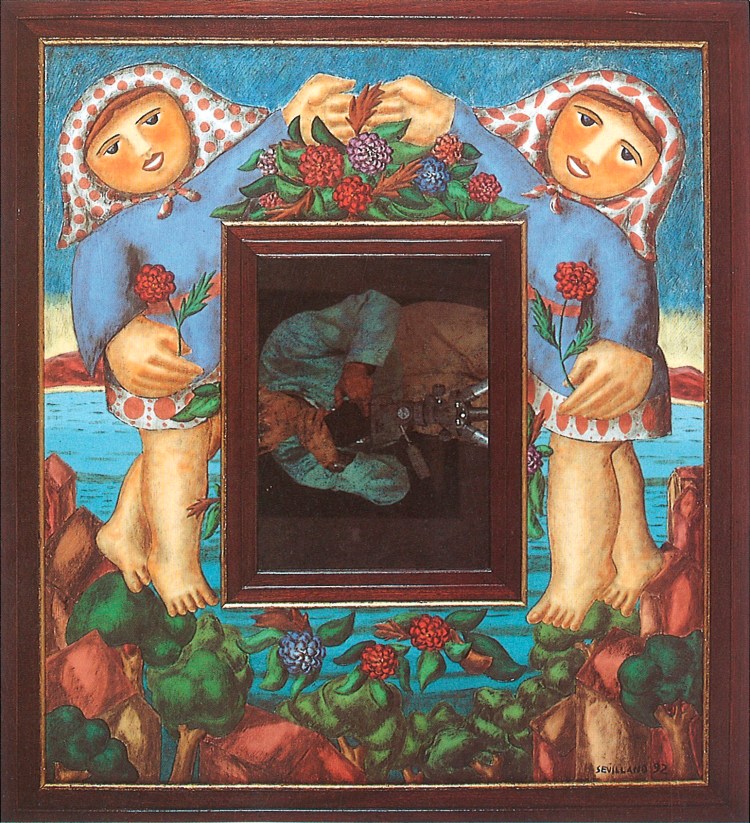
Mirror
Ángel Sevillano Estremera (1942 – 1994), Spain 1992
Mahogany wood, oil on wood, 24-karat gold leaf
Credits: Sevillano Collection. Galician, Spain
Two women with Galaico-style scarves raise their arms while floating in the air, in what seems to be an invitation to look at oneself in the mirror crowned by flowers that occupies the center. In the lower part, roofs of houses and trees, and in the background the Galician estuaries with their mountains. The interior trim of the mirror is covered in 24-karat gold leaf; the mirror glass has a fine aged layer that shows the passage of time.
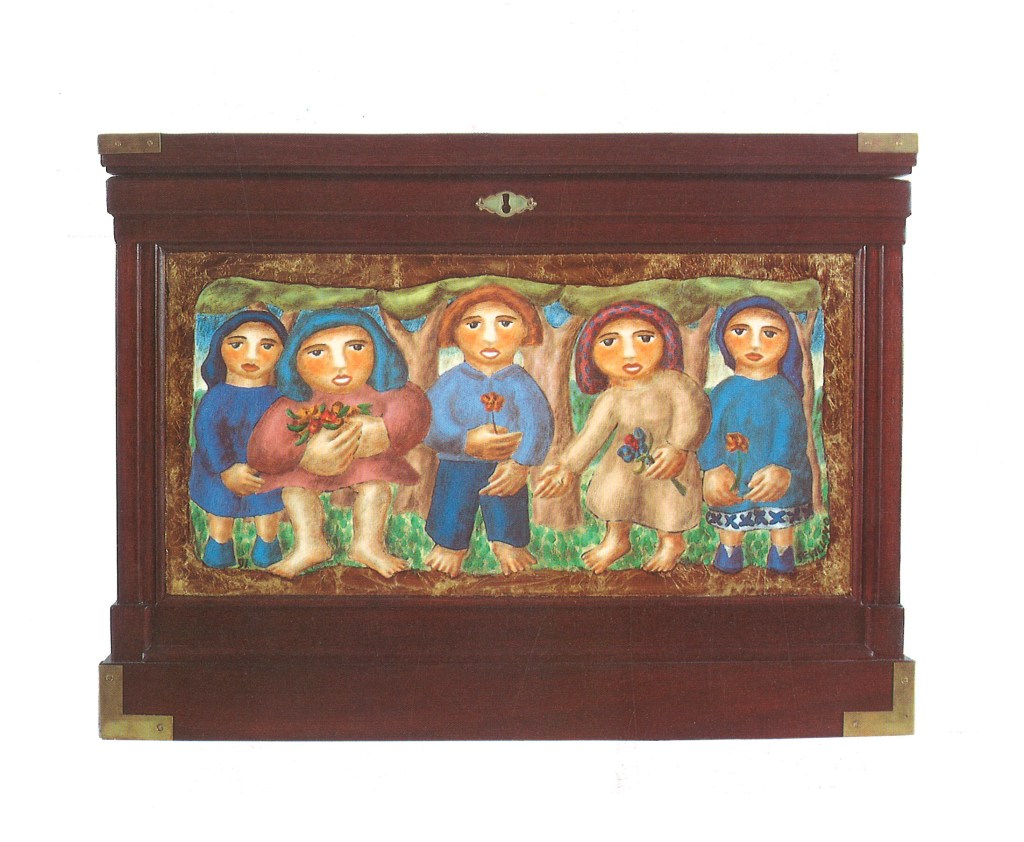
Trunk
Ángel Sevillano Estremera (1942 – 1994), Spain 1992
Mahogany wood, oil on wood, 24-karat gold leaf
Credits: Sevillano Collection. Galician, Spain
A small chest consisting of three oil panels: one on the front and two on the sides, where you can see a group of characters in a forest, carrying flowers in their hands. 24-karat gold leaf application around each panel, and bronze hardware.
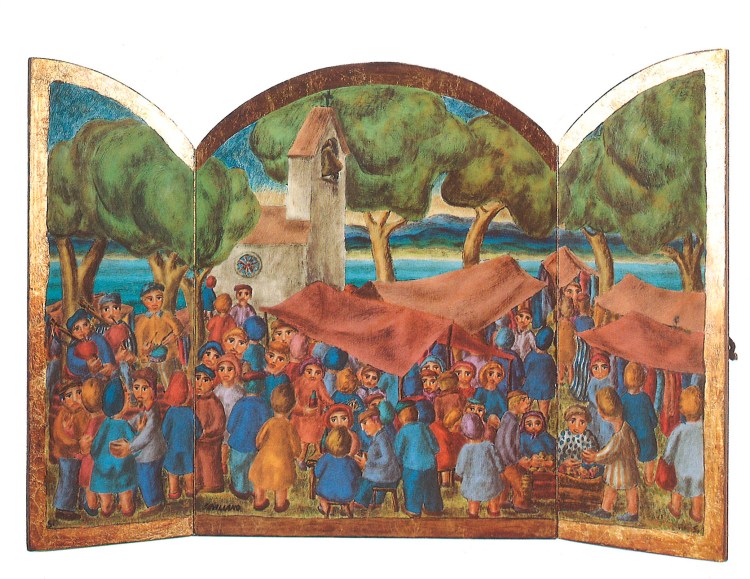
Triptych Pilgrimage
Ángel Sevillano Estremera (1942 – 1994), Spain 1992
Mahogany wood, oil on wood, 24-karat gold leaf
Credits: Private Collection
Last known sale in Galicia, Spain
One of the four existing triptychs of Sevillano. In this small reliquary we can see a crowd celebrating a traditional Galician pilgrimage. Folk music piper groups liven up the party, while some people dance and others have a snack at the food stalls that are under the awnings. We can even see the typical donut vendors at one of the tables. All this in what appears to be the church square of a town.
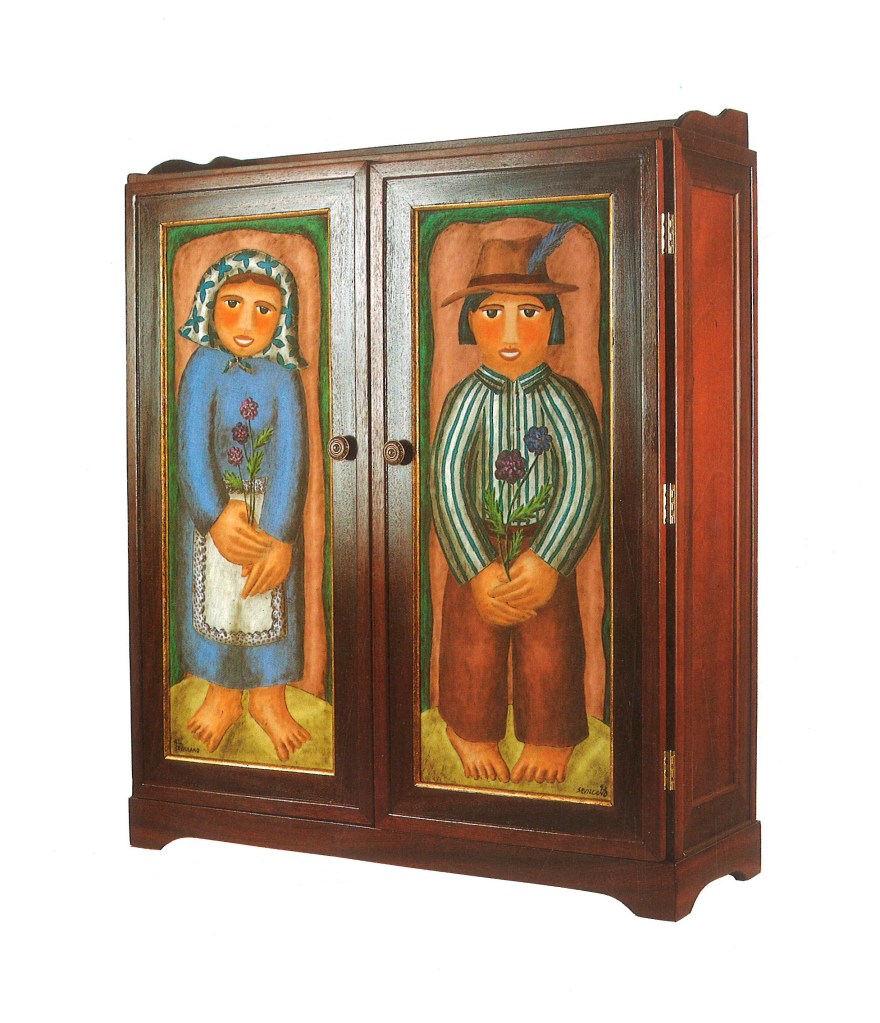
Closet
Ángel Sevillano Estremera (1942 – 1994), Spain 1992
Mahogany wood, oil on wood, 24-karat gold leaf
Credits: Private Collection
Two characters guard each of the closet doors: Galician and peasant, carrying flowers in their hands and dressed in the usual way. The panel moldings are covered in 24-karat gold leaf. Bronze ironwork and mahogany wood.
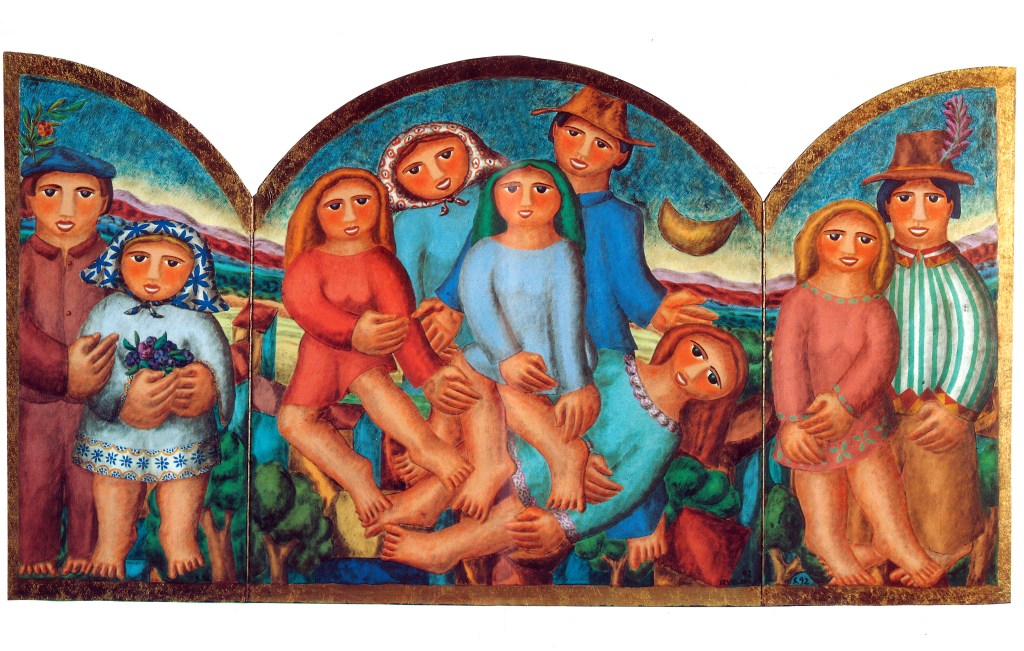
Etheric Triptych
Ángel Sevillano Estremera (1942 – 1994), Spain 1992
Mahogany wood, oil on wood, 24-karat gold leaf
Credits: Sevillano Collection. Galician, Spain
Reliquary in mahogany wood with oil panels and 24-karat gold leaf application. A group of Galician and American characters appear suspended in the air in a surreal way. Roofs, trees and mountains in the background on a night with a crescent moon.
Tribute to Sevillano
Collection




This website has been created by the Sevillano family. The total or partial reproduction of the contents of this website, including but not limited to images, texts, artworks, and any other material, is expressly prohibited without the explicit written authorization of the rights holders. Any unauthorized use will constitute a violation of intellectual property rights and will be subject to corresponding legal actions. Sevillano Art 2021 – 2023, All Rights Reserved.
 Colección Sevillano